 Purchasing
 Inventories and waste
 Analytics and performance
 Recipe cards
 Production management
 HACCP
 Mobile app
 Invoices and prices
 AI assistant
 Multi-location groups
 Casual dining
 Fast food
 Hotels
 Food courts
 Bakeries
Inventory management
How to manage your recipe cards in a restaurant

Inventory management: why recipe cards matter in restaurants
The financial benefits
Accurate production costs
Recipe cards let you calculate the cost price and production cost of each dish, taking into account the quantities required, unit prices and labor costs. Creating a recipe card helps you set more competitive selling prices and protect the profitability of your restaurants.
Keep stock at the right level
By controlling the quantities of products needed for each dish and finished product, you avoid losses from expired products. It will also help you define the safety stock you need to run your restaurants well.
Better negotiation with suppliers
Knowing exactly how many ingredients you need lets you negotiate prices with your suppliers more effectively. You can then get better rates, which helps reduce costs.
The benefits for your teams
Simpler inventory management:
Recipe cards let you calculate the total theoretical quantity of raw materials consumed over a given period. You can then compare it with the quantities actually used, taking stock variations into account.
Time savings:
Each recipe card sets out the preparation steps to guarantee the quality of the final product and speeds up dish preparation. By following recipe cards, cooks can work more smoothly, which improves kitchen productivity.
Organize your production:
Kitchen recipe cards help organize kitchen tasks efficiently. Cooks can plan preparation steps and quantities ahead to anticipate stock-outs and avoid food waste. It also prevents delays and oversights during service.
Fewer mistakes in the kitchen:
With standardized, well-documented recipes, cooks will make fewer preparation mistakes in portion sizes. You can include a photo to guide the cook on plating.
How do you create a kitchen recipe card?
Create an effective recipe card in 8 steps:
1. List of ingredients:
- List all the ingredients needed to prepare the dish. Specify exact quantities and units of measure (grams, milliliters, tablespoons, etc.). Also specify the particular quality of the ingredients (for example, “organic chicken”).
2. Description of the preparation steps:
- Break the preparation process down into clear, sequential steps. Specify cooking techniques, cooking times and temperatures where needed. Be precise to ensure consistent preparation.
3. Nutritional and allergen information:
- If relevant, you can include nutritional information such as calories, protein, fat and carbohydrates. This can be useful for health-conscious customers.
4. Preparation time:
- Give the estimated time needed to prepare the dish. This helps plan kitchen production.
5. Regular updates:
- Recipe cards must be updated regularly whenever recipes, costs or processes change.
6. Storage and organization:
- Make sure recipe cards are stored in an organized way and are easily accessible to kitchen staff.
⚠️ The financial indicators to take into account
7. Cost price:
- Calculate the cost price of the dish using the unit costs of the ingredients. This is the total cost of the raw materials needed to prepare a dish. By comparing this cost with the selling price, you can assess the profitability of each dish. 👉 A high raw material cost ratio can point to opportunities to optimize costs.
8. Suggested selling price:
- Based on the cost price, set a suggested selling price for the dish. Make sure it is competitive on the market while generating a satisfactory profit margin.
Good to know 💡
Based on the overall cost price,
you can set the selling price using a multiplier. This approach lets you factor various expenses, such as wages, overheads and equipment, into the selling price.

Free inventory management and kitchen recipe card software
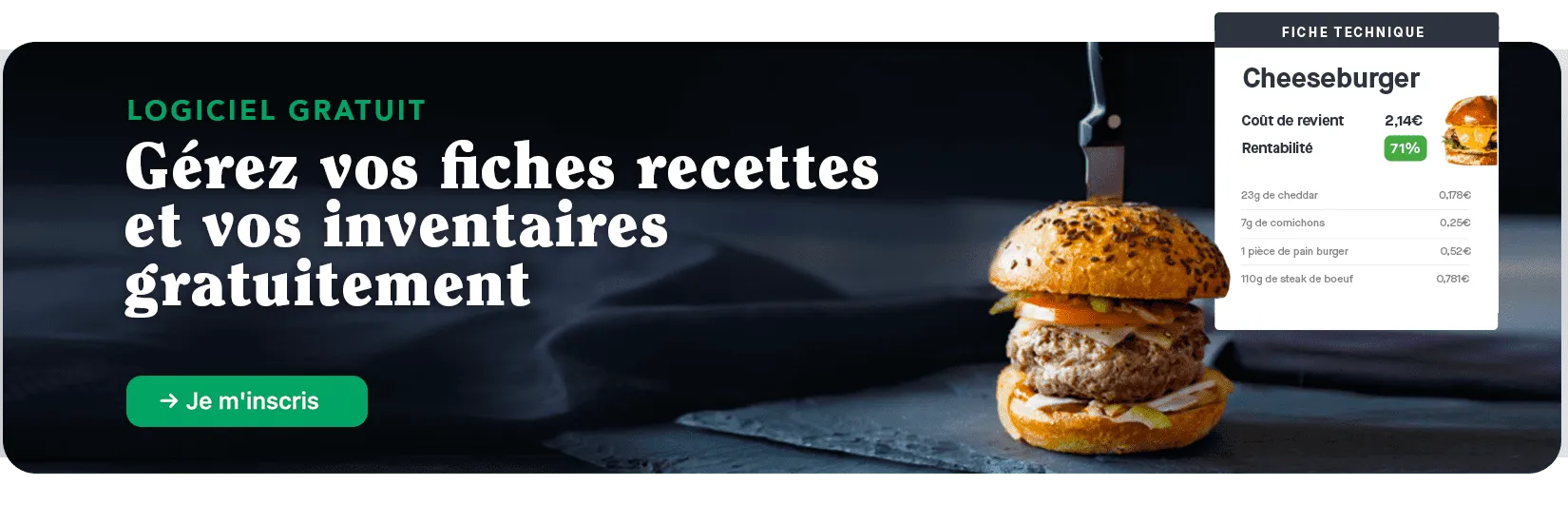
Yokitup has developed the first completely free tool for fast food and full-service restaurants, bakeries and hospitality businesses.
Sign up via the following link: Free inventory management software
Our solution lets restaurant professionals easily manage their recipe cards and run inventory counts. Leave outdated Excel spreadsheets behind. You analyze the cost price of every ingredient and the profitability of your dishes in real time.
Recipe cards are a cornerstone of restaurant management, especially for large restaurant chains. They support stock rotation, increase profit margins and simplify operations.
Want to know more? Book a meeting with our team to set up the best inventory management strategy for your restaurants.
Want to know more? Our team helps you set up the best inventory management strategy for your restaurants.