 Purchasing
 Inventories and waste
 Analytics and performance
 Recipe cards
 Production management
 HACCP
HACCP Mobile app
 Invoices and prices
 AI assistant
 Multi-location groups
 Casual dining
 Fast food
 Hotels
 Food courts
 Bakeries
Margins and food cost
How to calculate the price of a dish in a restaurant
How do you design your menu with menu engineering?
Categorize the dishes on your restaurant’s menu
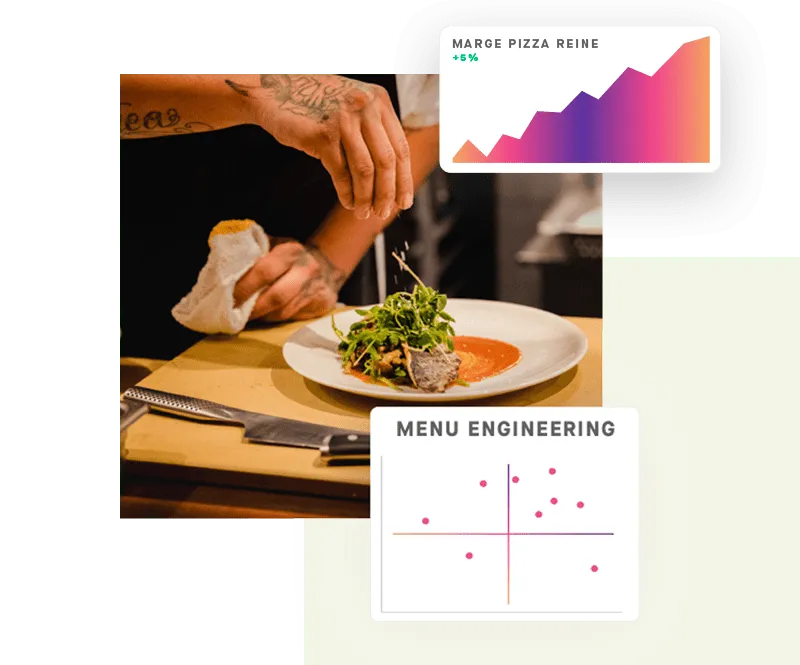
A restaurant can increase its profitability by 20% by highlighting its most profitable dishes and adjusting its prices. Menu engineering analyzes your customers’ ordering habits and categorizes dishes by evaluating their popularity and profitability.
- Stars: highly profitable and popular dishes. Showcase them and adjust their prices.
- Plowhorses: popular but less profitable dishes. Consider price adjustments or other ways to increase their profitability.
- Dogs: less popular and less profitable dishes. Decide whether they should stay on the menu or whether their ingredients should change.
- Puzzles: new or underperforming dishes whose potential is unclear. Test variations to gauge their appeal.
How do you set your target margin on sales?
3 indicators to take into account
Before setting prices, you must align the restaurant’s financial objectives with its pricing strategy. This means assessing:
- operating costs,
- profitability expectations,
- competitive position in the market.
By clearly defining these objectives, the restaurant can steer its pricing strategy to strike the best balance between appeal and profitability.
Calculating gross margin: selling price - food cost
Gross margin plays a central role in setting your menu prices. It is calculated as the difference between the selling price and the cost of raw materials, and represents the profit margin on revenue before operating costs are taken into account.
Optimizing gross margin means finding the right balance between competitive prices and enough profitability to cover your costs. In the restaurant industry, gross margin is usually between 65% and 75% of the selling price excluding VAT, which corresponds to a food cost of 25% to 35%. It is calculated as follows.
👉 Gross margin = Selling price - food cost
Control raw material costs by calculating the cost price
This approach adds up the food cost per portion, taking into account every ingredient used in the recipe.
However, you also need to include production costs, such as staff wages and fixed costs (rent, electricity, etc.).
This calculation ensures that the selling price covers all the costs of preparing the dish, and therefore guarantees profitability.
👉 Cost price = Ingredient costs + Production costs
3 methods to set your restaurant menu prices
Method 1: the simplified “food cost” calculation
A simple but effective approach is the “food cost” method. It lets you set the selling price of a dish by dividing the cost of its ingredients by your target food cost percentage. This method is a quick way to set the prices of your dishes.
👉 Selling price excl. VAT = Ingredient cost / Target food cost percentage
To set this percentage, rely on your actual food cost: (Opening inventory value + Purchases - Closing inventory value) / Sales revenue.
💡 Good to know
The cost of the ingredients used to prepare a dish should not exceed 30% of its selling price.
Example: you want to set the selling price of a burger. If its ingredients cost €2 and you target a 30% food cost, the selling price of your burger will be: 2 / 30%, i.e. €6.67 excluding VAT.
To learn more about the key ratios, read how to optimize your restaurant margins.
Method 2: optimize prices with Omnes’ principles
Omnes’ principles for restaurants cover various strategies to optimize costs, maximize profitability and attract more customers. Here is how they can be used to price your dishes:
- Price range
Offer a varied range of dishes at different price points to attract different customer segments. For example, more affordable dishes can encourage a first visit, while premium options can maximize profitability.
- Price spread
Price some dishes higher than others to give customers a variety of choices. This maximizes sales by satisfying a wider range of customers.
- Adjusting the offer to demand
If certain dishes are in high demand, the restaurant can raise their prices and maximize profits. By highlighting its dishes, the restaurant can also influence customers’ choices and maximize profitability.
Method 3: analyze and readjust your menu prices
Sales analysis helps identify trends, successes and opportunities for improvement. This includes adapting prices and costs to the menu’s actual performance. If some items are particularly successful, you can consider adjusting their prices to maximize sales.
At Yokitup, we have designed a fully customizable dashboard that centralizes all your data in real time. By tracking each location’s key ratios in real time, restaurateurs quickly identify where savings can be made. This flexibility helps not only to improve financial results, but also to build customer loyalty.
Want to know more? Our team helps you set up the best inventory management strategy for your restaurants.